A major source of information about the Carrier language is the work of Father Adrien-Gabriel Morice (1859-1939). When he was posted to St. Joseph's School in Williams Lake in 1883 he had his first experience of Blackwater Carrier and Chilcotin and soon began to learn the Stuart Lake dialect from Jimmy Alexander (1868-1952), a student from Nak'az̲dli. Once he moved to Fort St. James in 1885 he was immersed in that dialect. He left Fort St. James in 1904 but continued to study the language, largely through correspondence with Louis-Billy Prince (1864-1962).
Most of the information that he recorded about the language is in his massive book The Carrier Language: a Grammar and Dictionary Combined, published in 1932 in two volumes totalling 1,351 pages. He also published various things in the language, mostly religious, the best known of which is the Prayerbook, published first in syllabics and then in the 1938 Third Edition in his roman writing system.
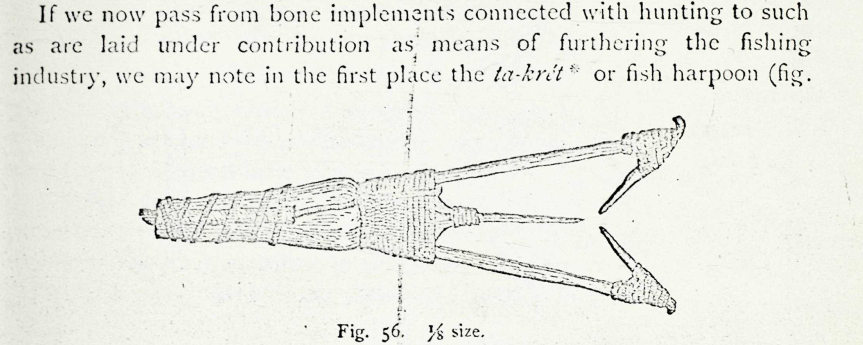
Some words are found in his publications about the culture. Here, for example, is the illustration of a fish harpoon in his Notes Archaeological, Industrial, and Sociological on the Western Dénés With an Ethnographical Sketch of the Same" published in the Transactions of the Canadian Institute in 1893. He gives the name as <ta-krét>, equivalent to CLC daget.
Father Morice's publications on anthropology include words in various Carrier dialects as well as in related languages, such as Sekani and Chilcotin. His Grammar and Dictionary, on the other hand, is devoted exclusively to the Stuart Lake dialect with the exception of a brief discussion of dialects and related languages on pp. 504-510 of Volume II.
When Father Morice wrote for a Carrier-speaking audience, he wrote in syllabics, but in his scholarly publications, intended for an audience that did not speak Carrier, he used a roman writing system. It is this writing system that he used in the third edition of the Prayerbook when the Bishop decided to abandon syllabics. Understanding How Father Morice Wrote Carrier is an explanation of his roman writing system for those familiar with the Carrier Linguistic Committee system.
The Carrier Language: a Grammar and Dictionary Combined is not in print. Copies are available from time to time on the used book market, at a cost of $1000 or more. However, PDFs containing scans of it can be downloaded at no cost from Libraries and Archives Canada: Volume I Volume II
The great majority of the words in it can be found in my dictionary, both in the online Nak'albun Carrier Dictionary and in its print counterpart. For many people, this will be the most convenient approach since the spelling has been converted to the CLC system, many spelling errors have been corrected, the words are explained more clearly and verbosely than in Father Morice's terse presentation, and it can be searched more easily than Father Morice's book. There is also audio of many words.
If you look up a word and it has Father Morice's book as one of its sources, the section number preceded by "MO" will be among the list of sources at lower right.
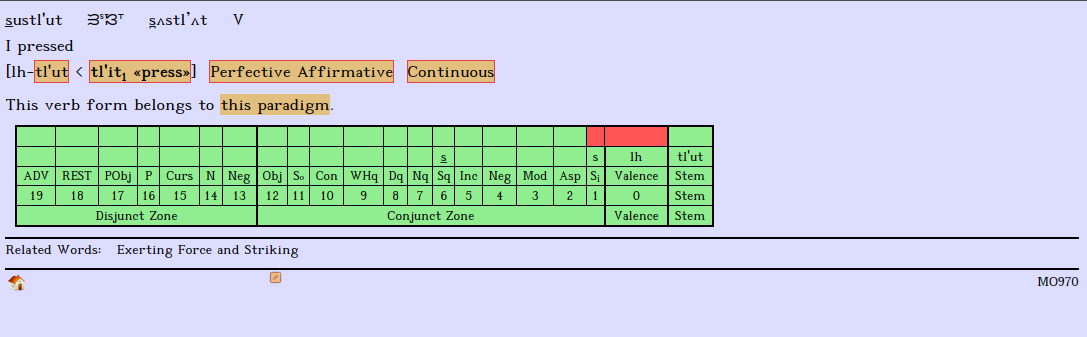
Clicking on this, in this case "MO970", displays an image of the page from Morice in another tab.
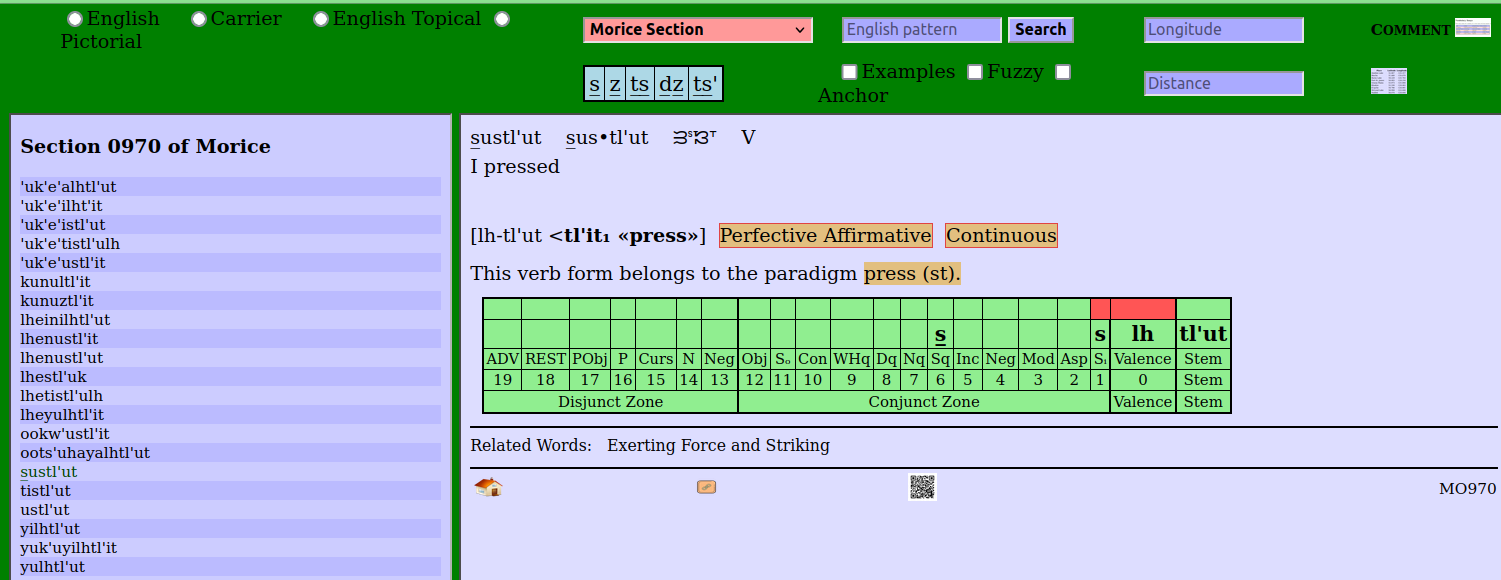
You can look up the words found in a particular section by using the "Morice Section" index.
If you are going to use the Grammar and Dictionary directly, the first thing you need to understand is its organization. It is not arranged like most other dictionaries. There is an alphabetical index of English words with pointers to the sections in which these words are discussed (pp 539-675 of Volume II), but you will not find an alphabetical list of Carrier words. Instead the words are arranged mostly on a grammatical basis.
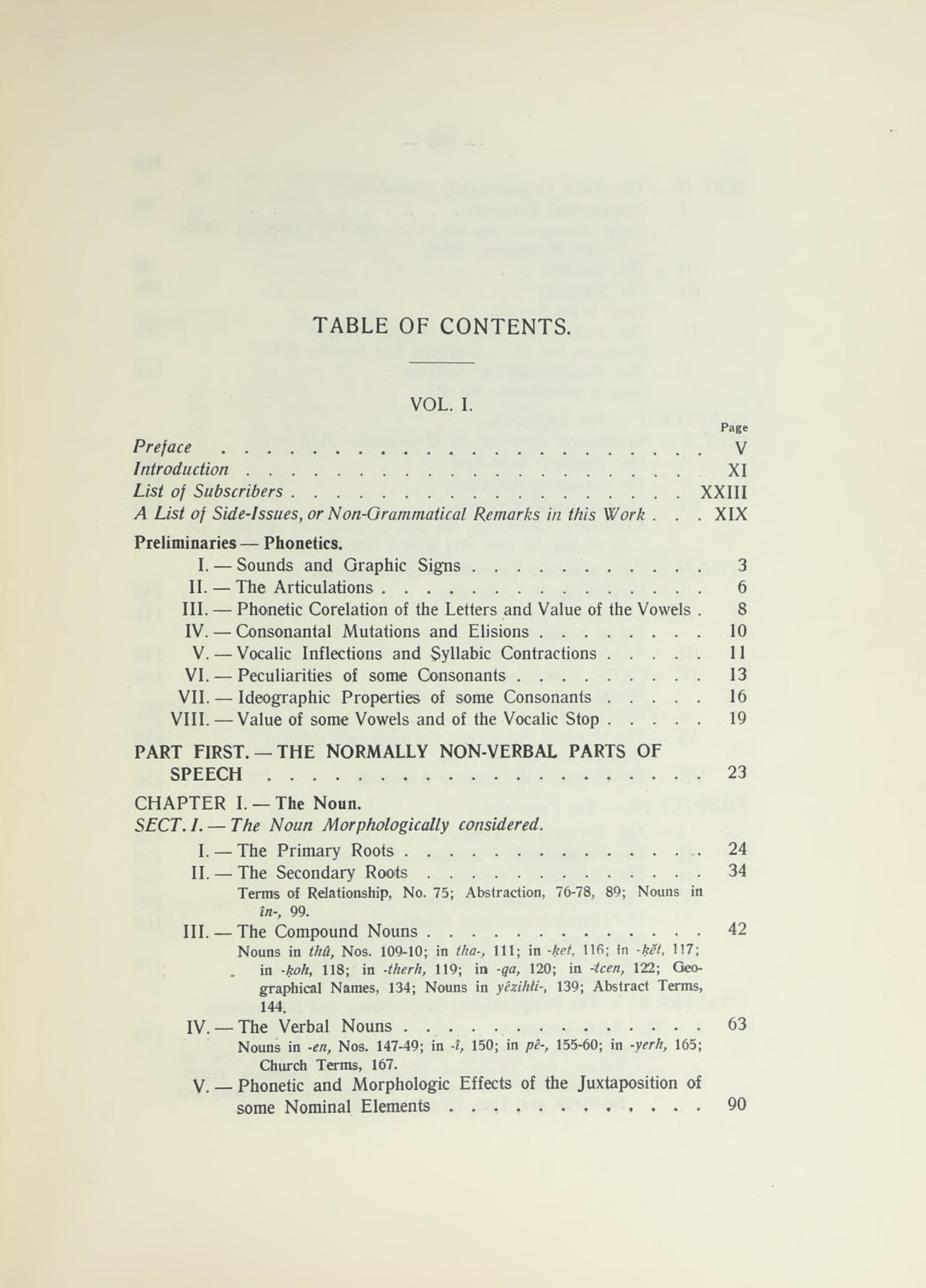
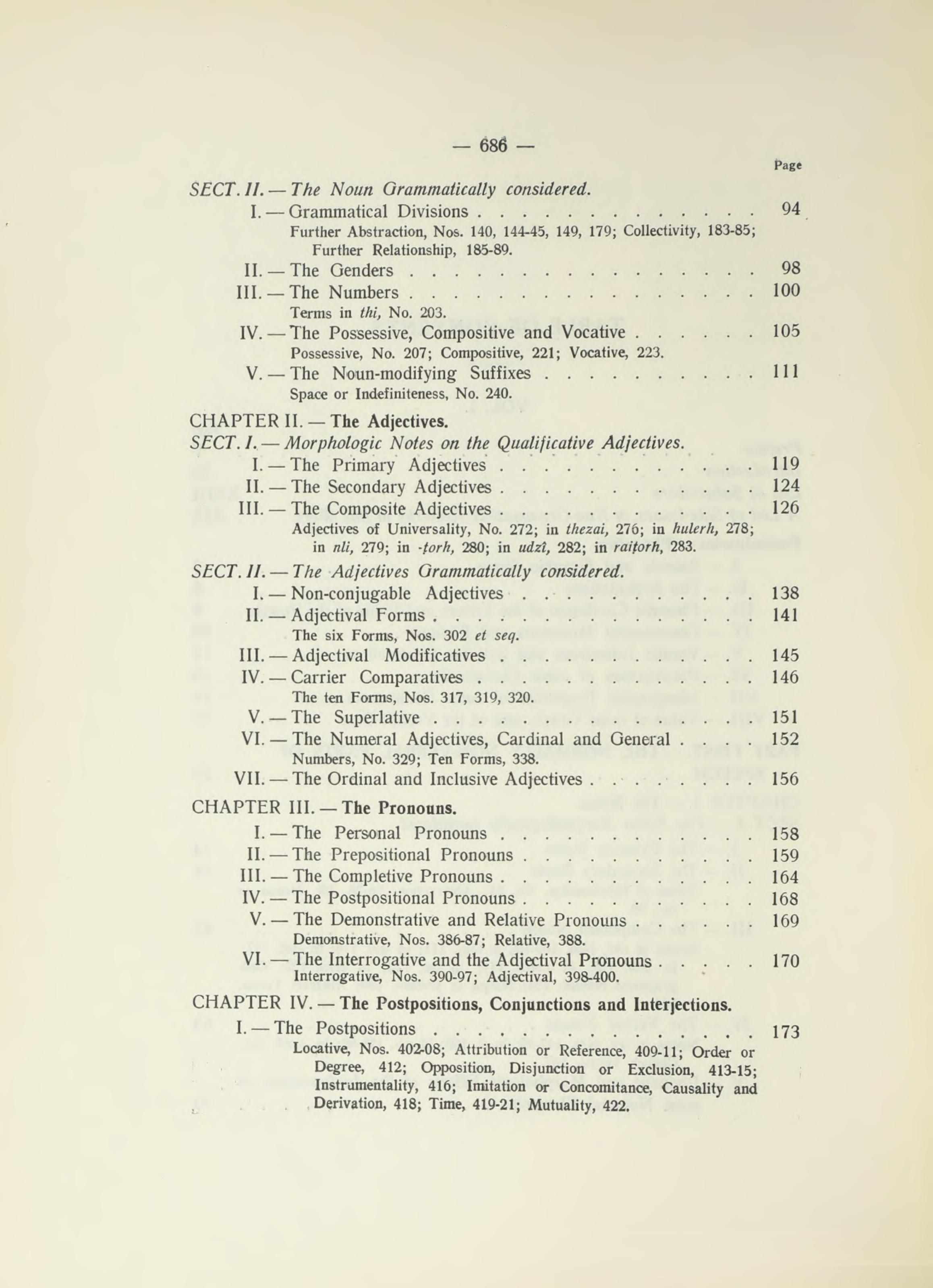
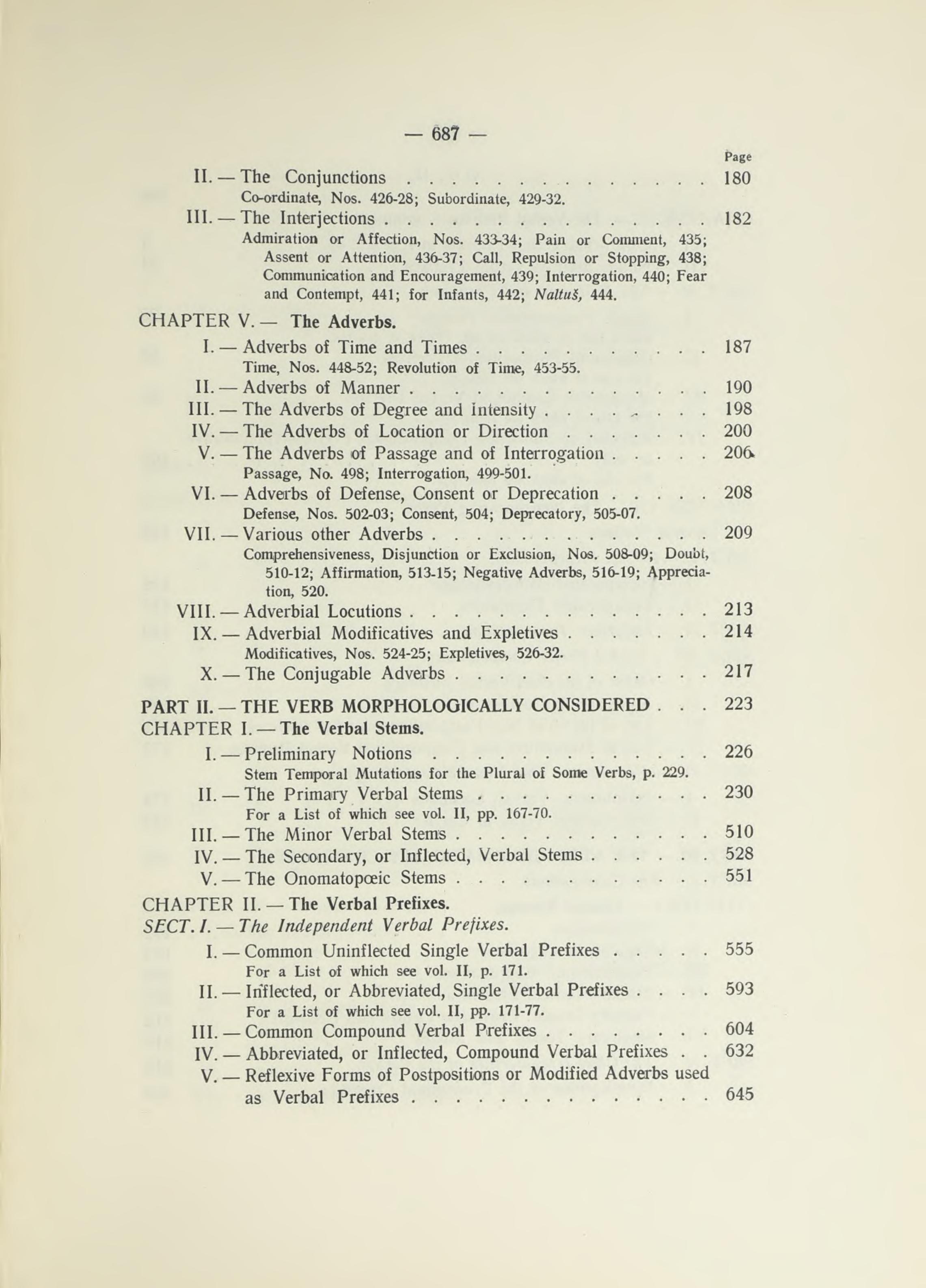
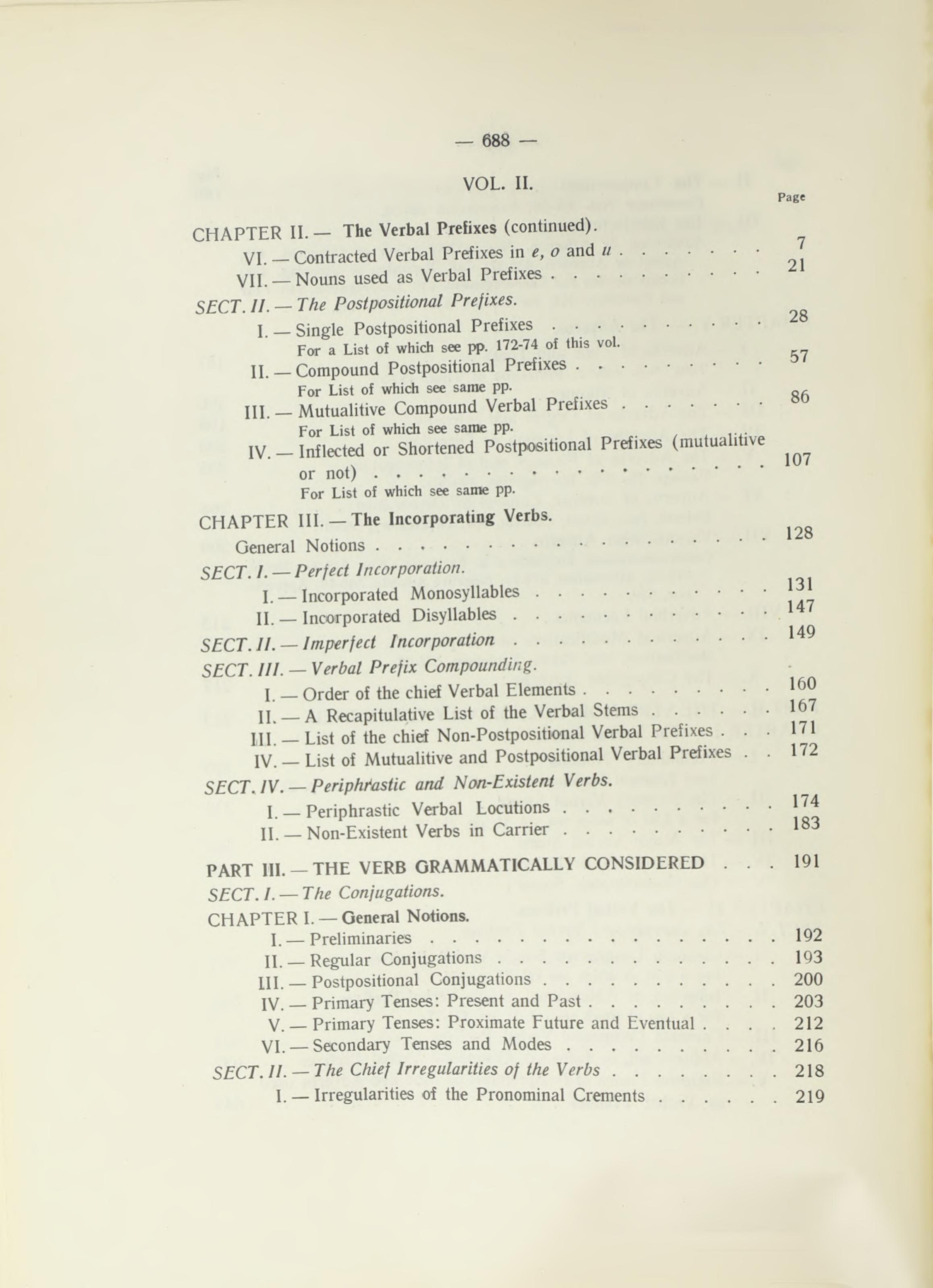
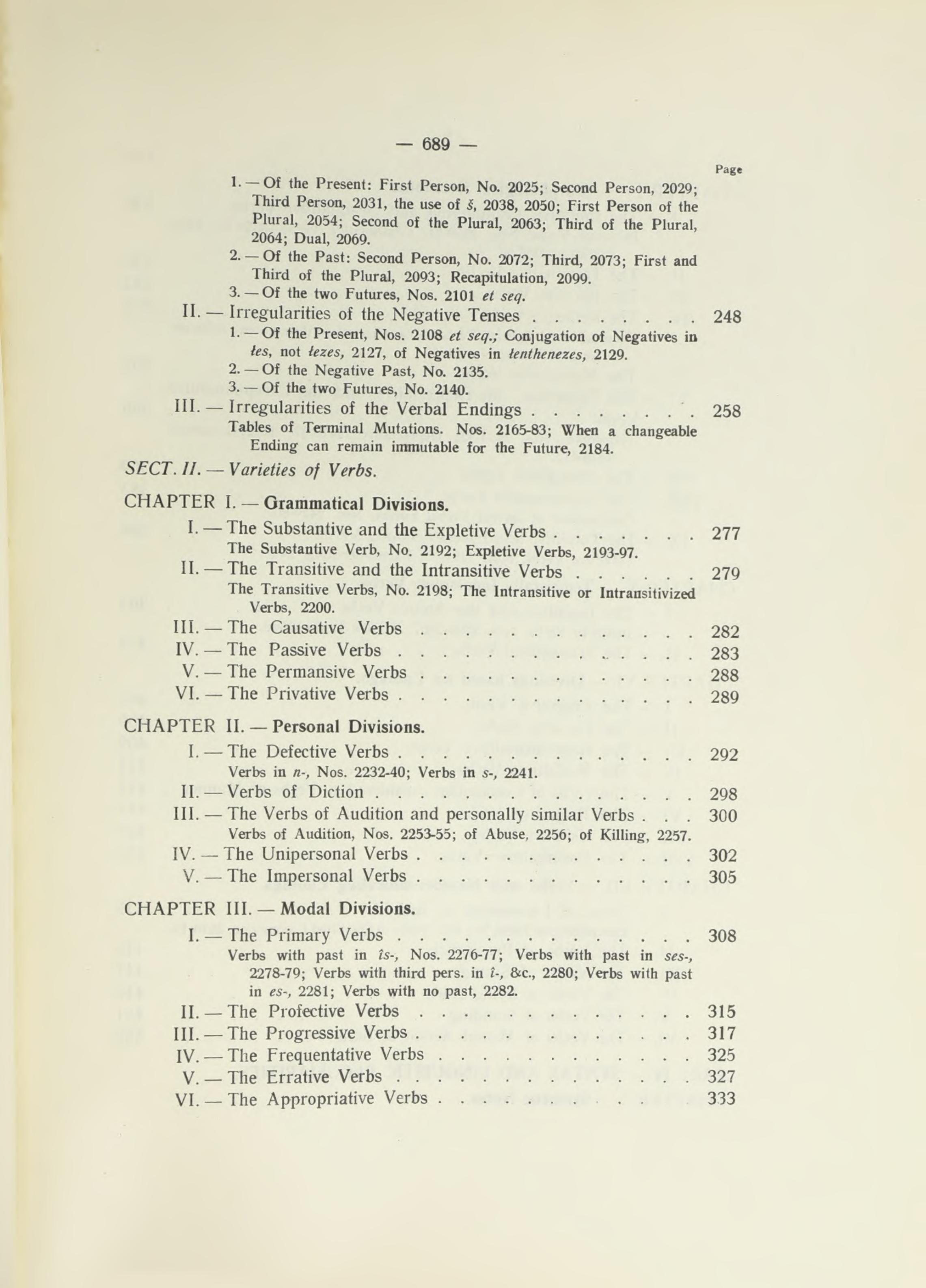
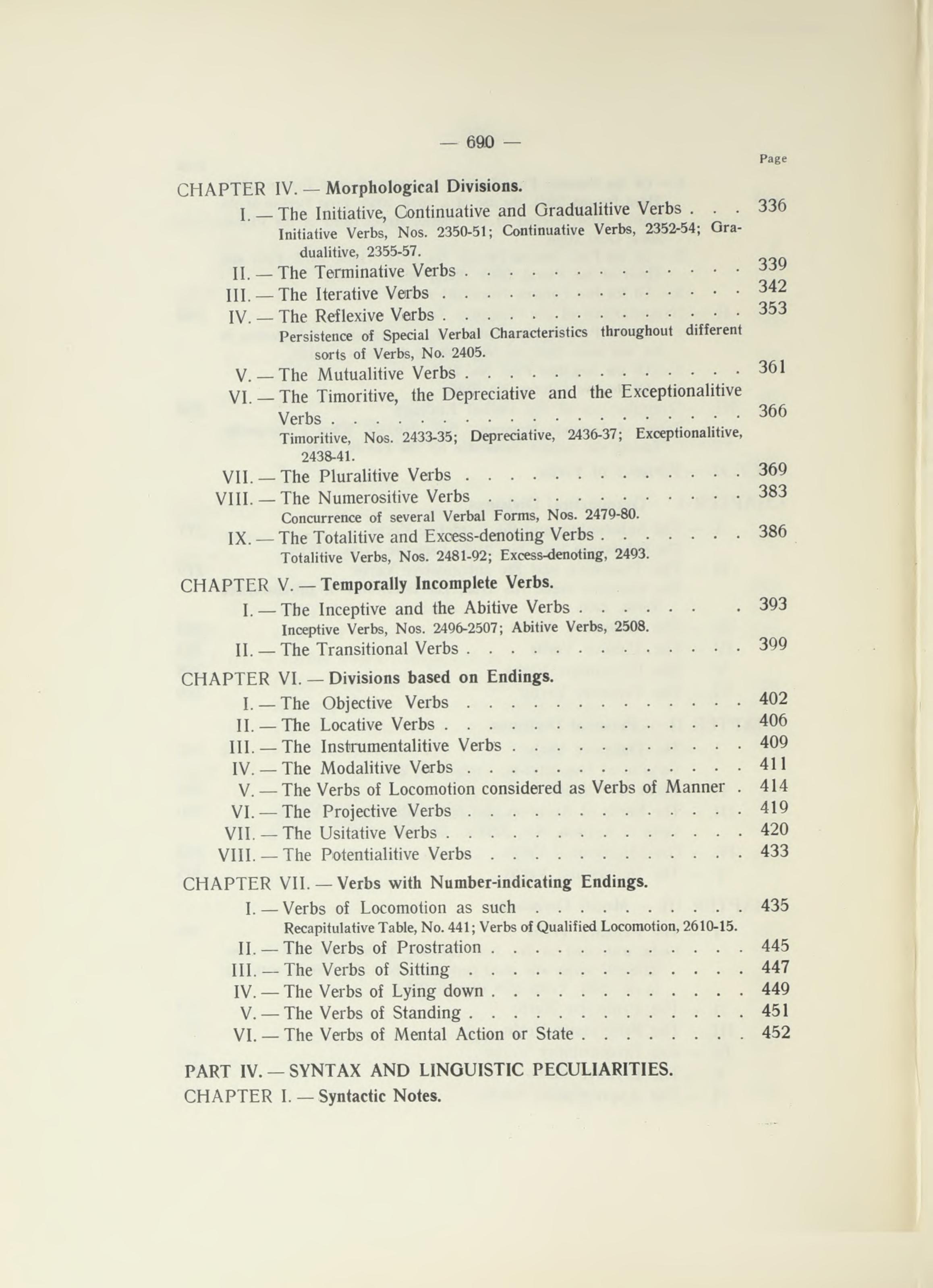
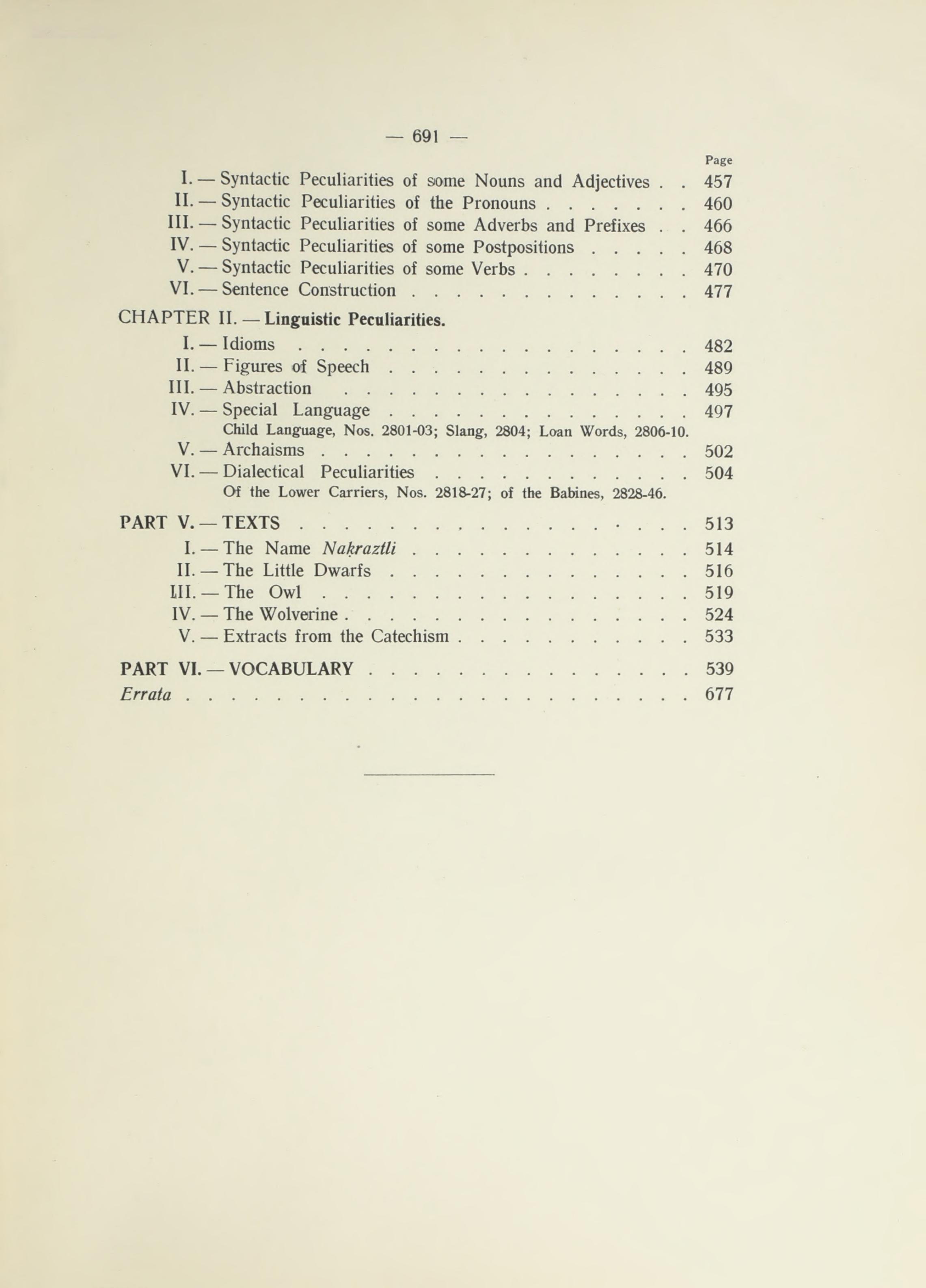
Here is the table of contents, which, following the French practice, is at the end of the book (pp. 685-691 of Volume II), not the beginning:
 |
 |
 |
 |
 |
 |
 |
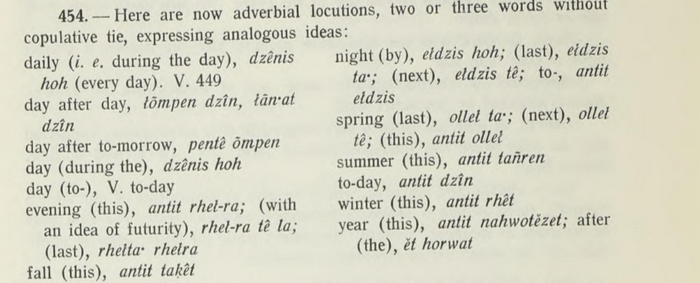
The book begins with a discussion of the sound system. That is followed by a part devoted to words other than verbs, arranged according to grammatical type. Within each section there is a list of words. Here is an example:
Most of the book is devoted to verbs. There are two major parts: one devoted to the various prefixes and one devoted to verb roots. Here, for example, is the beginning of section 651, on the root meaning "to travel by boat".
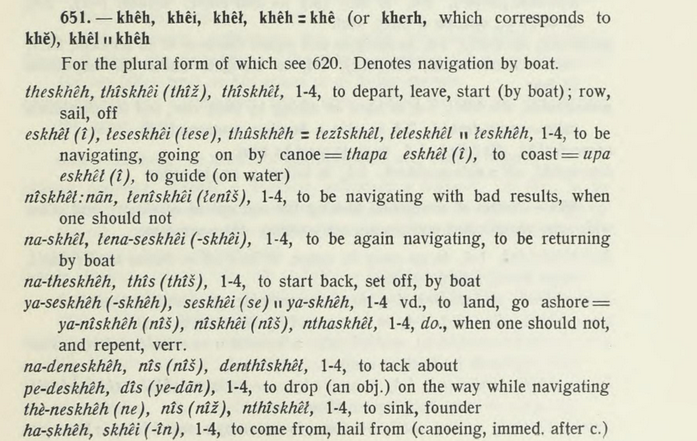
He first lists the various stems of this root, which change with tense and negation, and then gives a number of verbs based on this root. In each case he lists several forms, in different tenses, in a fixed order. The first entry, for example, indicates that "I depart by boat" is, to use modern CLC spelling, tuskeh, "I have departed by boat" is tiski, "(s)he has departed by boat" is tizk̲i, and "I will depart by boat" is tiskelh. To make use of the information about verbs you need to understand how Father Morice thought about Carrier verbs as well as his abbreviatory conventions. For example, in entries for verb roots like the one shown above, instead of labelling or translating verb forms, he lists thems in a certain order and has defaults for which subject form he includes. That is how we know that he is telling us that tuskeh above means "I depart by boat". Learning to interpret Father Morice's system is not trivial. An additional complication is that he did not always follow his own rules for presenting verbs.
It is important to be aware that that the pronunciation of the language has changed in some respects since Father Morice's time. That means that some differences between what he wrote and the pronunciation of current fluent speakers are not errors on his part. The major one is the change from ukh to oh. For example, the word “house” used to be pronounced yukh (in Morice's writing system yerh) but is now pronounced yoh. The late Nick Prince (1926-2003), remembered people who were elders to him using the old pronunciation recorded by Father Morice. In my dictionaries, entries based on Father Morice update the pronunciation since this is an exceptionless sound change. Whenever Morice wrote erh, the dictionaries have oh. If you want to know whether an instance of oh derives from earlier ukh or was always oh, you can click on the source link to see what Morice wrote.
Father Morice was the first person to recognize all of the distinctive sounds of an Athabaskan language and to create a writing system capable of representing (almost) all of them. Among other things, he recognized the glottal stop and provided letters for it both in syllabics and in his roman system. However, in practice, he frequently missed it. For example, in Section 454 above, the initial glottal stop is missing from all seven instances of the word 'andit "now", which is written <antit>, as well as from 'ulhdzis "night" and 'olulh "spring". When using his work you have to be aware that glottal stops may be missing, especially at the beginning of words and between vowels. (He was pretty reliable about syllable-final glottal stops.) People who rely heavily on Father Morice's work and cannot reliably hear the glottal stops themselves often mis-spell words due to Father Morice's incorrect spellings.
Father Morice set the type for his publications in syllabics himself, but his scholarly publications, in his roman system, were set from his manuscripts by printers who did not know Carrier and therefore could not easily catch their mistakes. This is especially true of his anthropological publications, which often contain errors. This is all the more true of publications by others which quote Carrier words from Morice.